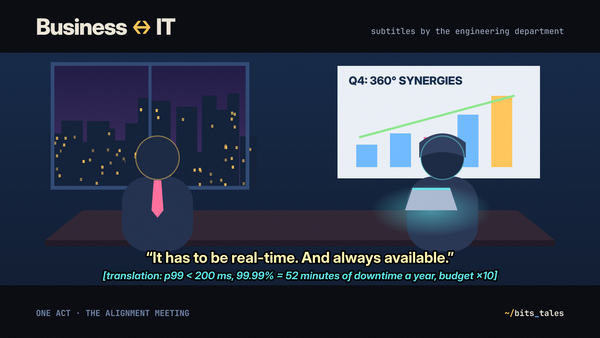
Software Engineering Business ↔ IT: the alignment meeting, with subtitles “Real-time”, “always available”, “it's just one more field”, “let's add AI”: a one-act play in a meeting room, with the Product Owner interpreting live and technical notes for every scene.
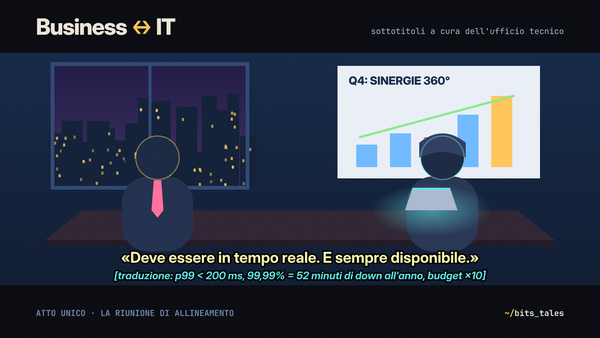
Software Engineering Business ↔ IT: la riunione di allineamento, con sottotitoli «In tempo reale», «sempre disponibile», «è solo un campo in più», «mettiamoci l'IA»: un atto unico in sala riunioni, con la Product Owner che traduce in simultanea e le note tecniche a piè di scena.
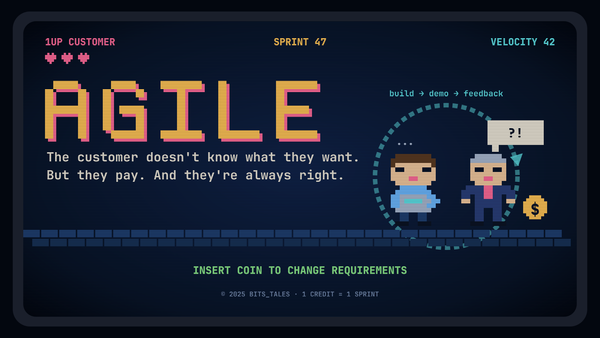
Software Engineering Agile, explained with a thermostat: the customer doesn't know what they want, but they pay (and they're always right) Open loop versus closed loop, a simulation of a customer who keeps changing their mind and an Agile–English dictionary: why we work in sprints, and what the customer is really always right about.
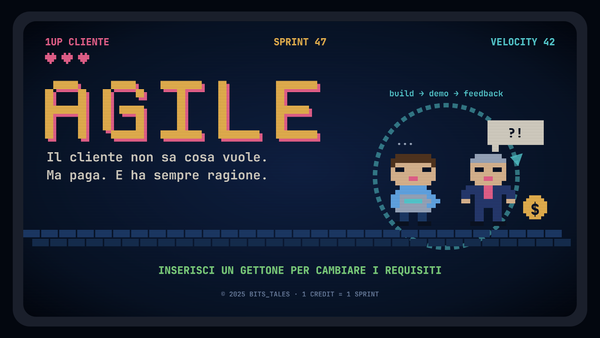
Software Engineering Agile, spiegato con un termostato: il cliente non sa cosa vuole, ma paga (e ha sempre ragione) Anello aperto contro anello chiuso, una simulazione del cliente che cambia idea e un dizionario Agile–Italiano: perché si lavora a sprint, e su cosa il cliente ha davvero sempre ragione.
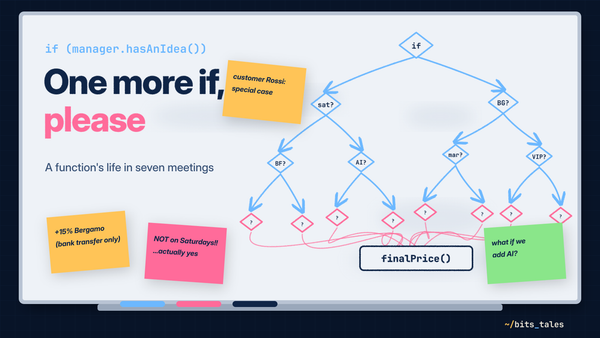
Software Engineering One more if, please: a function's life in seven meetings The business keeps changing its mind, a super-manager with a degree in Potato Chip Science has a vision, and finalPrice() goes from one line to a maze. Autopsy and treatment of if proliferation.
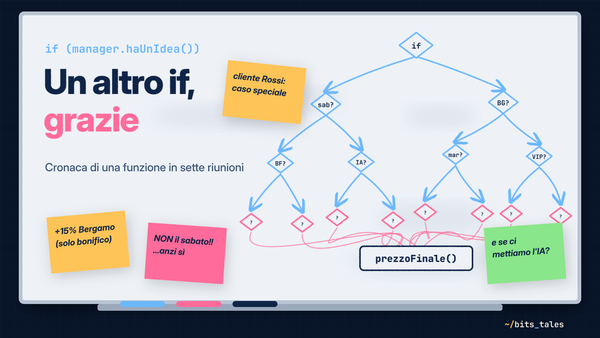
Software Engineering Un altro if, grazie: cronaca di una funzione in sette riunioni Il business cambia idea, il supermanager laureato in Scienze delle Patatine ha una visione, e prezzoFinale() passa da una riga a un labirinto. Autopsia e terapia della proliferazione degli if.
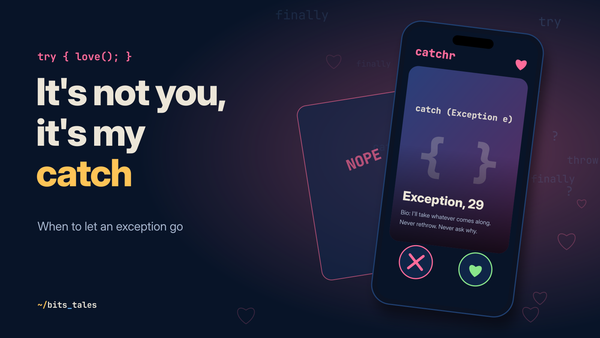
Programming It's not you, it's my catch: an advice column for exceptions Empty catches, bare excepts, endless retries, lost causes and return inside finally: Dr Finally answers your code's letters. Because catch is not always the answer.
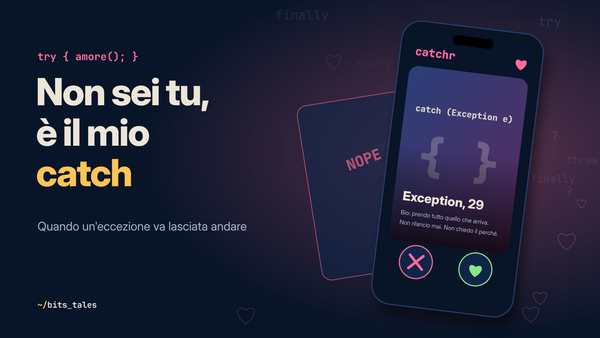
Programming Non sei tu, è il mio catch: la posta del cuore delle eccezioni Catch vuoti, except nudi, retry infiniti, cause perse e return dentro finally: la Dottoressa Finally risponde alle lettere del vostro codice. Perché catch non è sempre la soluzione.
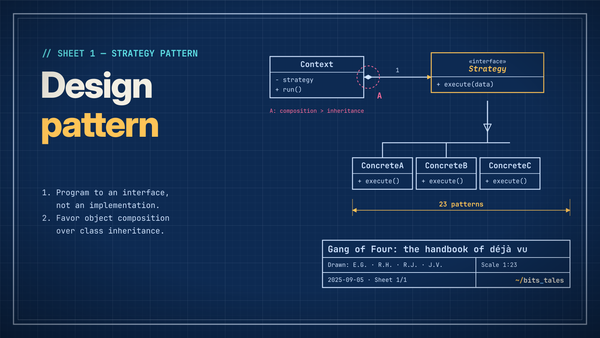
Software Engineering Design patterns: the catalogue entry for engineering's favourite pattern (software not required) The Gang of Four, Christopher Alexander, the H-bridge and the voltage divider: what a design pattern really is, explained with the GoF template applied to itself.
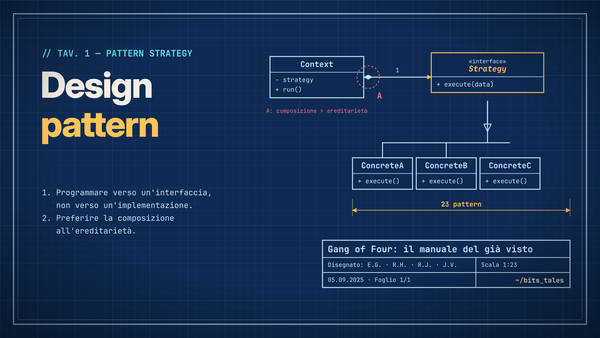
Software Engineering Design pattern: la scheda tecnica del pattern più usato dagli ingegneri (anche fuori dal software) La Gang of Four, Christopher Alexander, il ponte H e il partitore di tensione: che cos'è davvero un design pattern, spiegato con la scheda tecnica della GoF applicata a sé stessa.
Web Skip intro forever: the rise, glory and slow death of Flash From vector cartoons for 28.8k modems to the most exploited plugin on the Internet: SWF, ActionScript, JIT spraying, “Thoughts on Flash” and the kill switch that even stopped trains.
Web Skip intro per sempre: ascesa, gloria e lenta agonia di Flash Dal cartone vettoriale per modem a 28,8k al plugin più bucato di Internet: SWF, ActionScript, JIT spraying, «Thoughts on Flash» e il kill switch che ha fermato perfino dei treni.
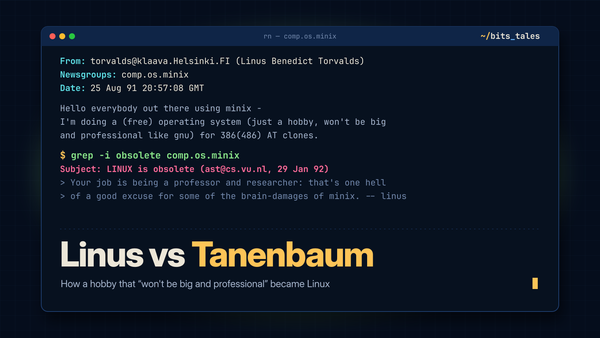
Linux Linus vs Tanenbaum: how a hobby that “won't be big and professional” became Linux MINIX, a 386 bought on instalments, “just a hobby” and the “LINUX is obsolete” flame war: microkernel versus monolithic, and how both sides ended up winning.
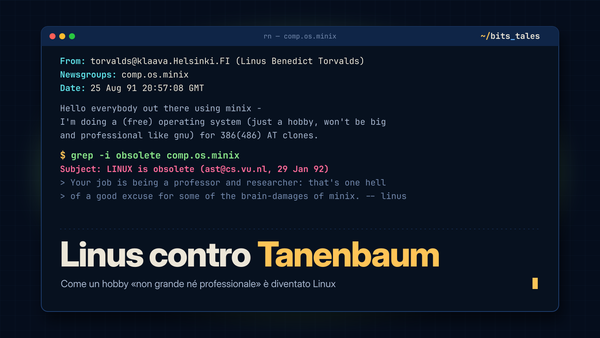
Linux Linus contro Tanenbaum: come un hobby «non grande né professionale» è diventato Linux MINIX, un 386 comprato a rate, «just a hobby» e la flame war «LINUX is obsolete»: microkernel contro monolitico, e come alla fine hanno vinto tutti e due.
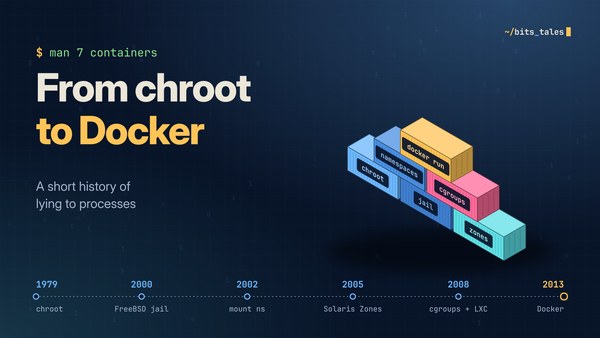
Linux From chroot to Docker: a short history of lying to processes Containers, namespaces, cgroups, OverlayFS: 34 years of well-coordinated lies the kernel tells processes, from 1979's chroot to Docker's whale.
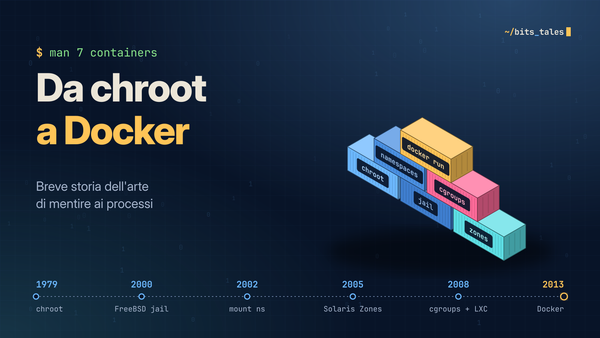
Linux Dal chroot a Docker: breve storia dell'arte di mentire ai processi Container, namespace, cgroup, OverlayFS: 34 anni di bugie ben coordinate raccontate dal kernel ai processi, dal chroot del 1979 alla balena di Docker.