
Same slide, new word: twelve years of buzzwords on the same Excel file
Big Data, Cloud, Blockchain, IoT, Quantum, Metaverse, generative AI and now Agentic: Dr Brambilla's kickoff folder, one slide a year. What they thought these were, what they really are, and three questions to ask before the next word.
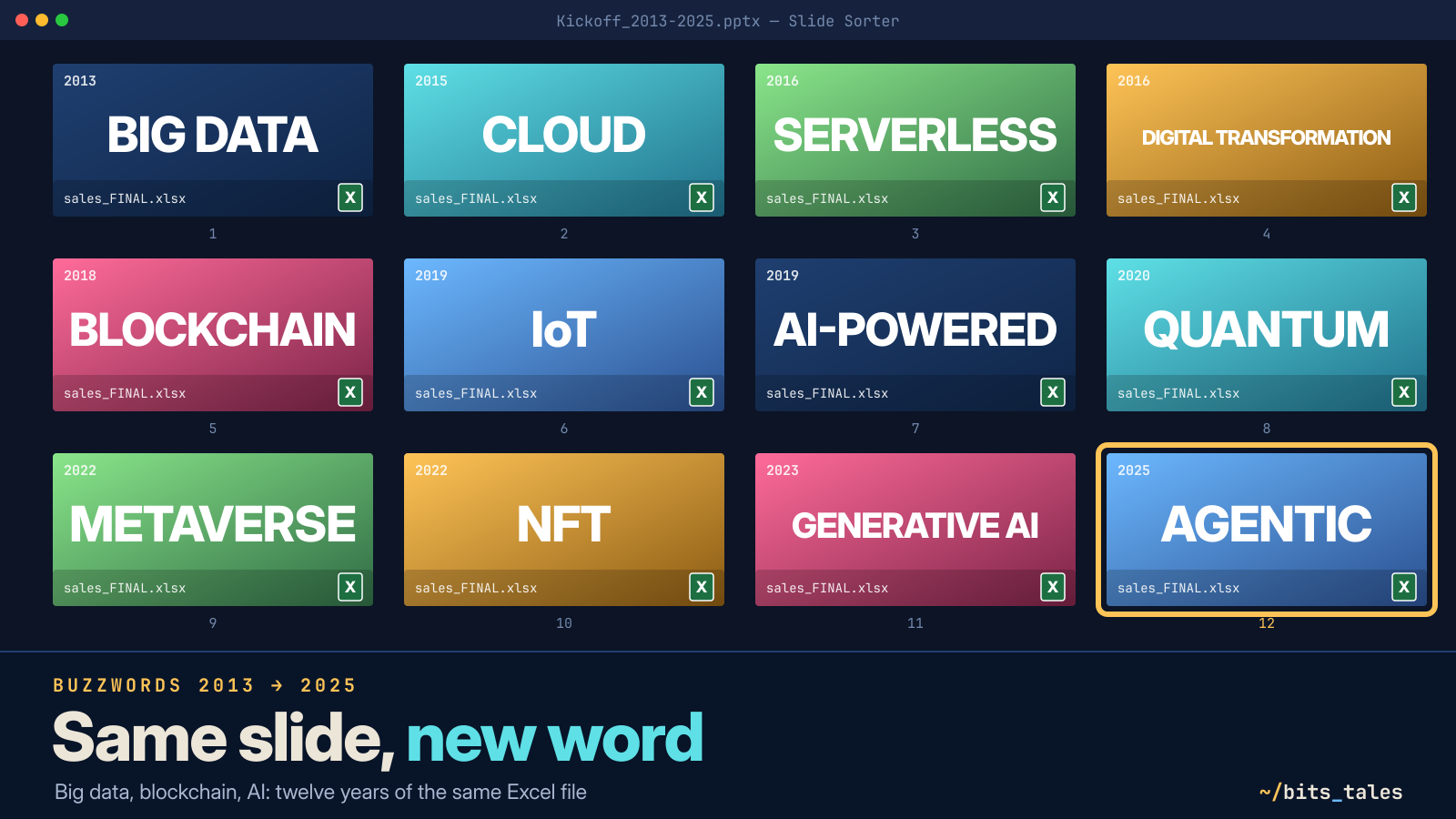
Sunday 14 September, evening. Tomorrow is the fourth-quarter kickoff, and Dr Brambilla has already sent the draft of the opening slide. A single word, in an enormous font: AGENTIC. Underneath, smaller: "Autonomous agents for the sales dashboard".
You know the sales dashboard well. It's an Excel file, sales_FINAL_v3_LATEST.xlsx, which you inherited the day you joined the company in 2013. It hasn't changed much since: a few extra columns, a macro nobody dares touch, a pie chart. What has changed every year is the name Brambilla gives it on his slides.
To work out what to say tomorrow, you open the shared folder Kickoff/. There's one presentation per year. You flip through them in order, like a family album.
2013 — Big Data
The first slide shows zeros and ones raining from the sky, and a title: Entering the era of Big Data. The project: "analyse sales data with Big Data technologies".
The term has a precise definition, born in a 2001 note by analyst Doug Laney: data that strains traditional tools through its volume, velocity or variety. To handle it, Hadoop appeared in 2006, inspired by Google's MapReduce: spread the computation over hundreds of machines because the data won't fit on one. Your dataset, on the other hand, fitted comfortably on a laptop:
$ wc -l sales.csv
40213 sales.csv
$ duckdb -c "SELECT region, sum(amount) FROM 'sales.csv' GROUP BY region"
# answered in a few milliseconds, on a laptop
A rule of thumb engineers have repeated for years: if the data fits in your computer's RAM, it isn't big data. It's data. The real problem in 2013 wasn't volume, it was Excel. Public Health England found out the worst way, in October 2020: COVID test results went through a file in the old .xls format, which stops at 65,536 rows. Extra rows were simply dropped. About 16,000 positive cases didn't reach contact tracing for a week. Hadoop wasn't needed: a database was.
2015 — Cloud (and then serverless)
Two years later the rain of zeros and ones turns into a cloud. The dashboard moves to the Cloud. In practice the file is moved onto a rented virtual machine, with the same Excel on top, and a monthly bill arrives that nobody had budgeted for.
Engineers have a sticker for this: There is no cloud, it's just someone else's computer. There's no cloud: there's someone else's computer in an air-conditioned shed, and you rent it by the hour. Sometimes that's a great deal (variable load, no hardware to manage, ready-made services), sometimes it isn't. 37signals, the company behind Basecamp, bought its own Dell servers in 2023 and estimated savings of about 7 million dollars over five years compared with its AWS bill.
In 2016 the slide gets an update: Serverless. Here too the name is more ambitious than reality: the servers are very much there, you just don't see them and you pay per invocation. In 2023 Amazon's own Prime Video team described moving one of its monitoring services from a distributed serverless architecture back into a single application, cutting infrastructure costs by over 90%. The message isn't "cloud is wrong". It's that every architecture comes with a bill, and someone has to read it.
2016 — Digital Transformation
The 2016 slide has a butterfly emerging from a cocoon. Digital transformation. The project: paper order forms are scanned to PDF and attached to the dashboard. Two months later someone asks for the PDFs to be printed, "because they're hard to read on screen".
A real digital transformation changes the process, not the medium: if an order moves from a paper form to a web form that writes straight into a database, with field validation and no retyping, that's transformation. If the sheet becomes a PDF of the same sheet, it's a very expensive photocopy. No wonder that, according to a 2020 BCG analysis of nearly nine hundred initiatives, 70% of digital transformations fall short of their objectives.
2018 — Blockchain
In January 2018 the slide is golden: The dashboard on the Blockchain. It's not an isolated idea. A few weeks earlier a drinks company, Long Island Iced Tea, had announced it was now called Long Blockchain: its shares rose as much as 388% in a day. Kodak had unveiled KodakCoin and its stock had more than doubled. Long Blockchain never built any blockchain, was delisted from Nasdaq, and in 2021 the SEC charged three people with insider trading on the very announcement of the name change.
Technically, a blockchain is a list of blocks in which each block contains the hash of the previous one, plus a consensus mechanism that lets parties who don't trust each other agree on what's written in it. The first part fits in ten lines:
import hashlib, json

chain = [{"index": 0, "data": "genesis", "prev": "0" * 64}]

def append(data):
    prev = hashlib.sha256(json.dumps(chain[-1], sort_keys=True).encode()).hexdigest()
    chain.append({"index": len(chain), "data": data, "prev": prev})

append({"region": "Lombardy", "amount": 1200})
# change an old block and the next block's prev field no longer matches:
# to hide it you'd have to recompute the whole chain from there onwards
The second part, consensus, is the expensive one: and it's pointless if you're the only one writing. In 2017 two ETH Zurich researchers, Karl Wüst and Arthur Gervais, published a paper titled exactly that, Do you need a Blockchain?, with a flowchart. The questions are simple: are there several parties writing? Do they trust each other? Is there an always-online trusted third party? Brambilla's sales dashboard is written by a single company that trusts itself: the answer is a database with an append-only log table. Even where there were many parties, it wasn't enough: TradeLens, the shipping blockchain platform built by Maersk and IBM, was shut down in early 2023 because it wasn't commercially viable.
2019 — IoT and Artificial Intelligence
In 2019 the slide has a connected fridge and a glowing brain. IoT + AI to forecast sales.
IoT (the Internet of Things) is real and useful when a sensor measures something that wasn't measured before. Its symbol, though, remains Juicero: a 400-dollar Wi-Fi-connected juicer, backed by over a hundred million in funding, that squeezed bags of pre-chopped fruit and vegetables. In April 2017 Bloomberg showed in a video that the bags could be squeezed by hand with the same result. In September the company shut down.
On artificial intelligence, the best joke of the period is attributed to Mat Velloso, then technical adviser to Microsoft's CEO: "If it is written in Python, it's probably machine learning. If it is written in PowerPoint, it's probably AI." The dashboard's "predictive model", in fact, was this:
import numpy as np
months = np.arange(len(sales))
slope, intercept = np.polyfit(months, sales, 1)    # a straight line
forecast = slope * (months[-1] + 1) + intercept     # "AI-powered forecast"
A linear regression: eighteenth-century maths, very useful, but on the slide it had become "AI". It wasn't a one-off. In March 2019 the fund MMC Ventures analysed 2,830 European start-ups classified as artificial intelligence companies: for about 40% it found no evidence of AI material to the product. Often the label hadn't been chosen by the companies themselves, but nobody was in a hurry to correct it: "AI" start-ups raised 15 to 50% more funding.
2020 — Quantum
The 2020 slide is purple, with a stylised atom: Quantum-ready. A few months earlier Google had announced in Nature that its Sycamore processor had performed in minutes a calculation that, by its estimate, a classical supercomputer would take thousands of years to finish. A remarkable scientific result, on a problem built specifically to demonstrate it, with no practical application. Certainly not to spreadsheets.
There is, however, one quantum thing that really concerns the company, and it isn't on the slide: cryptography. A large enough quantum computer would break RSA and the elliptic curves that protect today's HTTPS traffic and VPNs. In August 2024 NIST published the first three post-quantum cryptography standards (FIPS 203, 204 and 205). The sensible thing to do isn't a "quantum strategy" for the dashboard, but an inventory of where and how the company uses cryptography, so it can be replaced when the time comes.
2022 — Metaverse, NFTs, Web3
At the end of 2021 Facebook had renamed itself Meta, and in January 2022 Brambilla's slide is a virtual office full of legless avatars: The dashboard in the Metaverse. On top of that, every quarterly report will be "certified as an NFT".
An NFT is a token on a blockchain that, in most cases, contains only a URL pointing to an image or a JSON file on an ordinary server. Moxie Marlinspike, the creator of Signal, demonstrated it in January 2022: he made an NFT that showed a different image depending on which site you viewed it from, and a poop emoji in his own wallet. "What you bid on isn't what you get," he wrote. Jack Dorsey's first tweet, sold as an NFT in 2021 for about 2.9 million dollars, was put back up for sale in 2022 with an asking price of 48 million: according to CoinDesk, the top bid was around 280 dollars.
The metaverse only looks like it did better. Reality Labs, the Meta division building it, has racked up operating losses of almost 70 billion dollars since 2020. Brambilla's virtual office, meanwhile, was visited by exactly one person: the consultant who sold it.
2023 — Generative AI
At the end of 2022 ChatGPT arrives, and the 2023 slide changes again: Generative AI first. This time, to be fair, the technology is real and impressive. A language model is, essentially, a function that given some text computes the probability of the next word, trained on an enormous amount of text. The idea, boiled down, fits in a few lines:
from collections import Counter, defaultdict
text = "the client wants the report the client wants the slide".split()
after = defaultdict(Counter)
for a, b in zip(text, text[1:]):
    after[a][b] += 1
print(after["client"].most_common(1))   # [('wants', 2)]
# an LLM does the same thing with billions of parameters and a long context
The problem isn't the technology: it's the label stuck on everything. The dashboard becomes "AI-powered" because it has a button that summarises the table. Brambilla isn't alone. In March 2024 the SEC, the US securities regulator, fined two investment advisers, Delphia and Global Predictions, for telling clients they used artificial intelligence in ways they didn't: the first penalties for what is now called AI washing.
2025 — Agentic AI
And you reach tomorrow's slide. Agentic. An agent is a system in which a language model doesn't just answer, but decides which actions to take (query a database, call an API, send an email) and executes them in a loop until it reaches a goal. It can be extremely useful. It can also email the wrong client at three in the morning.
Two numbers from this summer. In June Gartner predicted that over 40% of agentic AI projects will be cancelled by the end of 2027, due to rising costs and unclear value, and estimated that among the thousands of vendors calling themselves "agentic" only about 130 really are: the rest are agent washing, rebranding chatbots and automations that already existed. In August an MIT report claimed that 95% of generative AI pilots in companies produce no measurable effect on the bottom line. It's a survey, not a peer-reviewed study, and the figure has been disputed. But the authors' diagnosis is interesting: the problem isn't the model, it's how companies fit it into their processes.
Three questions
You close the last presentation. Twelve years, nine words, one Excel file. Every technology on the list is real, and in the right context it's even useful. What was missing each time wasn't the technology: it was the questions before the slide.
You open tomorrow's presentation and add one last slide, in a normal font:
- What problem does it solve? Said without the new word. If it can't be explained without it, there probably isn't a problem.
- How do we measure whether it works? One number, decided before starting: time saved, errors avoided, extra revenue.
- What's the boring solution? A database, a cron job, a script, a web form. If the boring solution solves the problem, it's almost always the right one.
On Monday morning Brambilla reaches your slide, reads it in silence and nods. Then he looks up: "Beautiful. Can we call it a framework?"
Sources
- Doug Laney, the original 2001 note on volume, velocity and variety
- The Register, Excel's row limit and the missing COVID cases (2020); The Conversation, Why you should never use Excel to count coronavirus cases
- DHH, The Big Cloud Exit FAQ; The Register, 37signals' estimated savings (2023)
- Network World, the Prime Video serverless-to-monolith case (2023)
- BCG, Flipping the Odds of Digital Transformation Success (2020)
- The Block, the SEC and the Long Blockchain case (2021); Bloomberg, Kodak and KodakCoin (2018)
- Wüst and Gervais, Do you need a Blockchain? (ETH Zürich, 2017); The Register, IBM and Maersk shut down TradeLens (2022)
- Fortune, Juicero is shutting down (2017); MIT Technology Review, 40% of Europe's "AI" start-ups without AI (2019)
- Arute et al., Quantum supremacy using a programmable superconducting processor (Nature, 2019); NIST, the first post-quantum standards (2024)
- Moxie Marlinspike, My first impressions of web3 (2022); CoinDesk, Dorsey's first-tweet NFT (2022)
- SEC, the first AI washing penalties (2024)
- Gartner, agentic AI project forecast (June 2025); Fortune, the MIT report on generative AI pilots (August 2025)